The Hidden Science of the Great Wildebeest Migration
Every year, across the grasslands of northern Tanzania and southern Kenya, an extraordinary natural system unfolds. Vast herds of wildebeest move through the Serengeti–Mara ecosystem, accompanied by zebras and other grazing animals. Their movements influence predators, vegetation, rivers and the wider ecological relationships that sustain one of Africa's most remarkable wildlife landscapes.
The Great Wildebeest Migration is often described through dramatic images of crowded riverbanks and animals moving across open plains. Yet these spectacles reveal only part of the story.
Behind the visible movement lies a complex interaction between rainfall, grass quality, animal behaviour, reproduction, competition and survival. Individual animals respond to their surroundings, while the combined movements of many individuals produce a migration that extends across an enormous landscape.
Understanding these relationships helps explain why the migration continues, why its timing changes, and why protecting the ecosystem requires more than conserving individual animals.
What Makes the Great Wildebeest Migration So Extraordinary?
The Great Wildebeest Migration is the seasonal movement of a large population of blue wildebeest (Connochaetes taurinus) across the Serengeti–Mara ecosystem of Tanzania and Kenya.
The migratory population is commonly estimated at approximately 1.2–1.3 million wildebeest, although population estimates depend on survey methods and the period being studied. Large numbers of zebras and gazelles also move through parts of the ecosystem.
What makes this migration particularly remarkable is its scale and its connection to changing environmental conditions.
Rather than travelling along a rigid route with a fixed timetable, the herds respond to the distribution of food and water. Rainfall changes grass growth, vegetation quality varies across the landscape, and the animals adjust their movements accordingly.
The result is a recurring ecological process whose general pattern is recognizable but whose exact timing and location can change from one year to another.
The Serengeti–Mara migration is therefore more than a journey undertaken by millions of animals. It is an example of how animal behaviour and environmental conditions interact to create a large-scale natural phenomenon.
1. Rainfall Is Only the Beginning of the Story
Rainfall is one of the most important influences on the migration, but its effects extend beyond simply filling rivers and watering grasslands.
When rain reaches dry or recently grazed land, plants begin growing. The amount of new growth, its nutritional quality and the time it remains available can vary considerably between different parts of the ecosystem.
Wildebeest need sufficient food to maintain their bodies, support reproduction and raise their calves. They therefore benefit from locating areas where grazing provides an appropriate balance of quantity and quality.
A landscape that looks green from a distance is not necessarily equally valuable to a grazing animal everywhere. Different grasses vary in their nutritional composition, while plant maturity and local soil conditions influence the food available.
This helps explain why the herds do not simply remain in the nearest green area. Their movements reflect a broader pattern of changing resources across the ecosystem.
Scientific research published in The American Naturalist found that seasonal rainfall patterns and differences in grass quality help explain the long-distance movements of Serengeti wildebeest.
The study also highlighted the importance of tracking resources across large distances rather than responding only to conditions in the immediate surroundings.
The key lesson: rainfall helps create the conditions for migration, but the distribution and nutritional value of grass help explain where the animals move.
Research reference: Holdo, Holt and Fryxell, “Opposing rainfall and plant nutritional gradients best explain the wildebeest migration in the Serengeti” (2009), The American Naturalist.
2. Why Grass Quality Can Matter More Than Green Colour
To understand wildebeest movement, it is important to distinguish between the amount of grass available and the nutritional value of that grass.
Young grass can provide important nutrients, including nitrogen-containing compounds needed for growth and body maintenance. As vegetation matures, its nutritional characteristics change, and the effort required to obtain sufficient food may increase.
For a large grazing herbivore, feeding is a balance between the energy and nutrients obtained and the time and effort spent finding and consuming them.
The southern Serengeti plains are especially important during the wet season because their short-grass areas can provide valuable grazing conditions. As environmental conditions change, other parts of the ecosystem become important.
The relationship between rainfall, soil fertility and vegetation quality creates a shifting landscape of feeding opportunities.
This is one reason the migration cannot be explained by rainfall alone. Two locations may receive rain but still differ in the quality, quantity and persistence of the forage they provide.
Researchers studying the migration have used vegetation information, rainfall data and animal movement records to investigate these relationships.
For wildlife ecology, the important question is not merely where grass grows, but how its distribution and quality influence the decisions and movements of grazing animals.
3. How Millions of Animals Move Without a Single Leader
A question often raised by observers is how enormous herds appear to move together across such a large area.
The answer is not that a single animal directs the entire migration.
Wildebeest live in social groups and respond to their surroundings, including the behaviour of nearby animals. Their movements can be influenced by local grazing conditions, environmental cues and the actions of other individuals.
When many animals respond to similar conditions, their movements can combine into a larger pattern across the landscape.
However, it would be misleading to imagine the entire migratory population behaving as one perfectly coordinated unit. Herds can separate, change direction, pause and follow different pathways.
Movement ecology distinguishes between individual decisions, local group behaviour and the resulting distribution of animals across an ecosystem.
Scientists use tracking data and mathematical models to investigate how these different scales interact.
GPS-based research in the Serengeti has helped researchers identify movement pathways and examine how environmental features and human activity influence the routes animals take.
This research provides a more detailed understanding of migration than photographs alone can offer. It helps reveal how a large-scale movement can emerge from the responses of individual animals to changing conditions.
Research example: GPS-based research on Serengeti wildebeest movement.
4. The Hidden Relationship Between Wildebeest, Zebras and Gazelles
Although wildebeest dominate many images of the migration, they are part of a wider community of grazing animals.
Zebras and gazelles share parts of the Serengeti–Mara landscape, but they do not necessarily use vegetation in exactly the same way. Differences in body size, feeding behaviour and digestive physiology can influence which plants or parts of plants different species consume.
These differences can produce interactions that are more complicated than simple competition for food.
A study published in 2024 investigated grazing relationships among migratory herbivores in the Serengeti using camera traps, GPS-collared animals and dietary evidence from faecal DNA.
The researchers found evidence of a dynamic relationship: grazing by larger animals could influence the conditions experienced by smaller grazers, while some species could also compete for resources.
The effects varied with environmental conditions, including rainfall and wildfire.
This research illustrates an important ecological principle: species that share a landscape may influence one another in several ways at once. One species can change the environment in ways that create opportunities for another, while also competing for some of the same resources.
The migration is therefore not simply a story about wildebeest. It is also a story about how different herbivores interact with vegetation and with each other.
Research reference: Interplay of competition and facilitation in grazing succession by migrant Serengeti herbivores (2024).

This image shows a massive herd of wildebeests and zebras crossing the open grassy plains during the Great Migration in Serengeti National Park
IMAGE/CREDIT TO NatGeo
5. How the Migration Shapes Predator–Prey Relationships
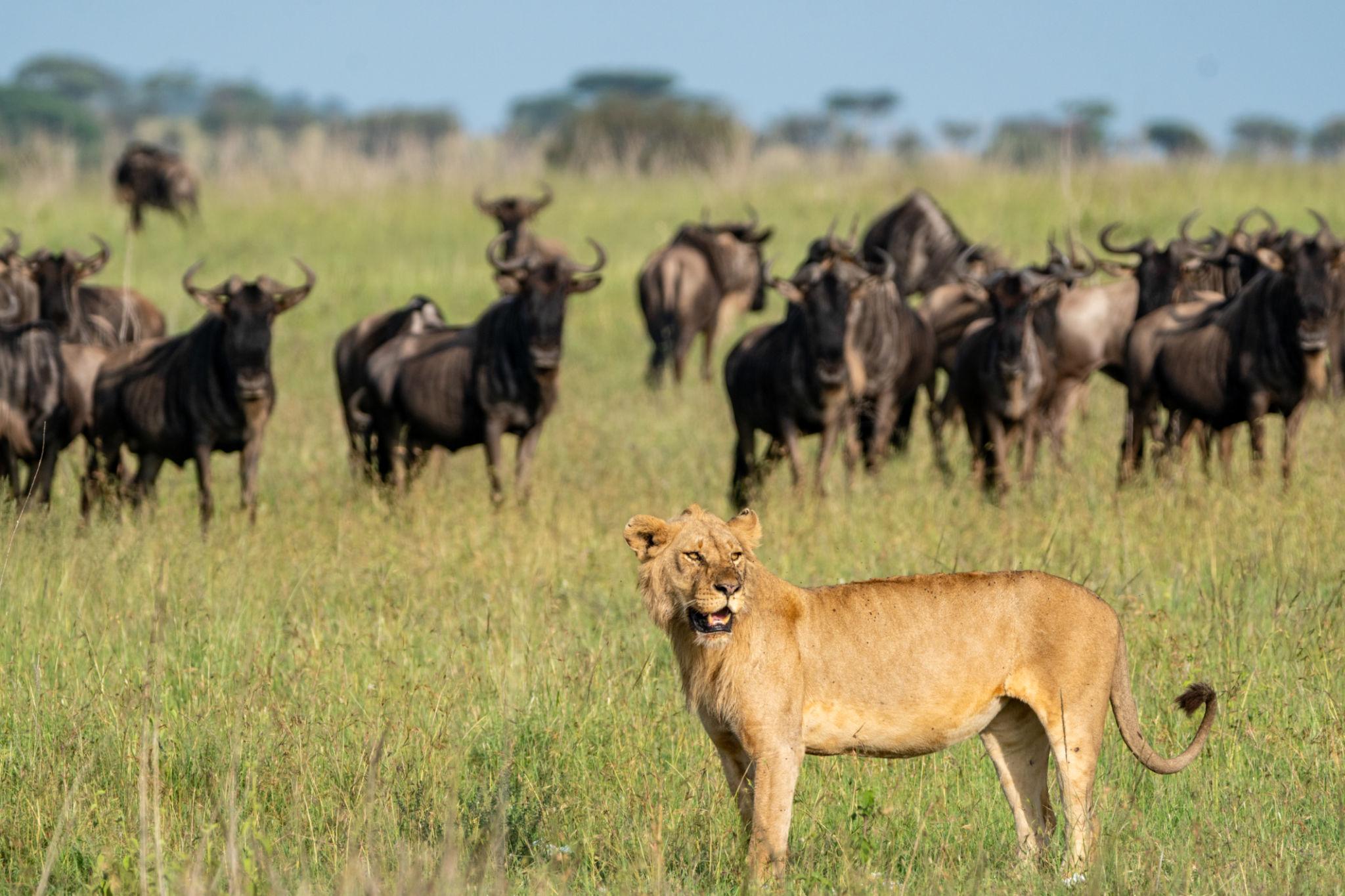
The movement of large herds creates changing opportunities for predators.
Lions, cheetahs, hyenas, leopards and crocodiles occupy different ecological roles within the Serengeti–Mara ecosystem. Their hunting strategies, preferred prey and habitats differ, so the arrival of large herbivore groups does not affect every predator in the same way.
Predators may benefit when prey becomes locally abundant, but hunting success is influenced by more than the number of animals present. Vegetation cover, prey age, group behaviour, terrain and the predator's hunting strategy can all affect the outcome.
The presence of many wildebeest also does not mean every individual is equally vulnerable. Healthy adults, young calves and weakened animals may face different risks depending on the circumstances.
Predation is a natural component of ecosystem function. It influences animal survival and can affect how prey animals use their environment.
For observers, dramatic hunting scenes are often the most visible interactions between predators and migratory herbivores. Ecologically, however, the relationship is continuous and extends beyond any single encounter.
The movement of prey affects where predators may find food, while the presence of predators forms part of the environment in which herbivores live and move.
Understanding these relationships helps explain why the migration supports a wider food web rather than one isolated wildlife event.
6. What Happens When Wildebeest Enter a River?
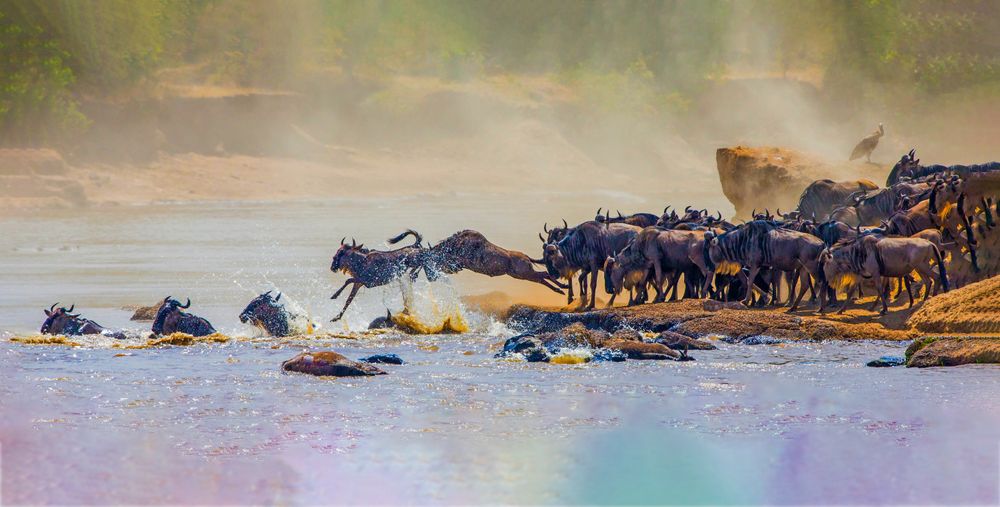
River crossings are among the best-known events associated with the migration. They are also examples of how the movement of terrestrial animals can influence aquatic ecosystems.
Crossing a river presents natural hazards. Animals may encounter strong currents, deep water, steep banks and crocodiles. Some may drown, particularly during large crossing events.
Although these losses can appear devastating, their ecological consequences extend beyond the immediate event.
A scientific study published in the Proceedings of the National Academy of Sciences investigated the effects of wildebeest carcasses entering the Mara River.
The researchers estimated that mass drownings involving more than 100 wildebeest occurred in at least 13 of the 15 years examined. Their analysis estimated an average of approximately 6,250 carcasses, representing around 1,100 tonnes of biomass, entering the river annually during the study period.
These are study-specific estimates, not a fixed annual count for every year.
The research showed that the remains contributed nutrients to the river ecosystem. Soft tissues decomposed over weeks, while bones could persist for years, supporting different pathways of nutrient cycling.
Nutrients from carcasses can be used by aquatic organisms and microorganisms, transported downstream or returned to terrestrial food webs by scavengers.
This is a striking example of ecological connectivity. The movement of wildebeest across grasslands can influence processes occurring in rivers, demonstrating how the effects of migration extend beyond the animals themselves.
Research reference: Subalusky and colleagues, “Annual mass drownings of the Serengeti wildebeest migration influence nutrient cycling and storage in the Mara River” (2017), PNAS.
7. How Scientists Study the Migration
Observing large herds in the field provides valuable information, but understanding migration across an entire ecosystem requires more than occasional sightings.
Researchers combine several methods to investigate animal movement and its environmental drivers.
GPS tracking
GPS collars can record animal locations at regular intervals, allowing researchers to study movement pathways, travel distances and changes in behaviour over time.
These records help scientists examine how individual animals respond to vegetation, terrain, water sources and areas of human activity.
Satellite imagery
Satellite observations can help researchers monitor vegetation conditions across large landscapes. Measures of vegetation greenness can provide useful information about changes in plant growth, although greenness alone does not reveal every aspect of forage quality.
Rainfall and climate data
Rainfall records help researchers examine relationships between seasonal weather patterns, plant growth and the distribution of migratory animals.
Comparing these records with animal locations can help identify environmental conditions associated with changes in movement.
Aerial surveys and field observations
Aerial surveys can estimate animal distribution over large areas, while ground-based observations provide detailed information about behaviour and local ecological conditions.
Each method has limitations. GPS collars usually track a sample of animals rather than every member of the population, while satellite observations and aerial surveys involve their own uncertainties.
Combining different forms of evidence allows scientists to build a more reliable picture of the migration.
8. Why Migration Corridors Are Essential
A migration depends not only on the quality of its seasonal destinations but also on the ability of animals to move between them.
Grasslands, water sources, seasonal feeding areas and connecting landscapes form part of the wider system. If animals cannot move between important areas, they may lose access to resources needed at different times of the year.
Human activities can create obstacles to movement. Roads, fences, settlement expansion and changes in land use can alter the routes animals take or restrict access to important habitats.
Research on Serengeti wildebeest has investigated how barriers to movement could affect population dynamics and ecosystem processes.
The Convention on the Conservation of Migratory Species of Wild Animals also documents the importance of migration routes and the effects that barriers can have on migratory wildlife.
These findings highlight why conservation cannot focus only on protected areas considered individually. The connections between them may be equally important.
Protecting migration corridors requires planning across landscapes and, where necessary, cooperation between countries, conservation authorities, communities and land managers.
A healthy migration depends on maintaining the conditions that allow animals to move, feed and reproduce throughout their annual cycle.
Further reading: Convention on Migratory Species: Fact Sheet on the Wildebeest Migration.
9. Can Climate Change Alter the Great Wildebeest Migration?
The migration is closely connected to rainfall and vegetation, so changes in environmental conditions can influence the resources available to migratory animals.
However, it is important to distinguish between observed seasonal variability, long-term environmental trends and specific changes that have been demonstrated to affect wildebeest movement.
Rainfall can vary between years, and local conditions can differ across the Serengeti–Mara ecosystem. A change in the timing or distribution of rainfall may alter where nutritious grass becomes available and how long it remains suitable for grazing.
Other factors, including habitat fragmentation, human infrastructure and changes in land use, can also affect movement opportunities.
Climate change may influence these processes, but it should not automatically be blamed for every unusual migration pattern or individual river crossing.
Scientists investigate these questions by combining long-term movement records with rainfall observations, vegetation data and information about changes in the landscape.
This evidence-based approach is important because conservation decisions depend on understanding the actual drivers of change rather than relying on assumptions.
The central issue is how the ecosystem responds to interacting pressures and whether migratory animals can continue to reach the resources they need.
10. Why the Great Wildebeest Migration Matters Beyond Tourism
The migration is an extraordinary wildlife spectacle, but its importance extends beyond its appeal to visitors.
It provides opportunities to study animal movement, population dynamics, grazing ecology, predator–prey relationships and the connections between terrestrial and aquatic ecosystems.
It also demonstrates why ecological processes operate across large geographical areas. Animals move between seasonal habitats, interact with multiple species and contribute to the functioning of the landscapes through which they travel.
The migration supports tourism economies and creates opportunities for education, research and conservation awareness. These benefits depend on maintaining healthy wildlife populations and landscapes while managing tourism and other human activities responsibly.
For students, the migration connects biology, geography, environmental science and conservation. For researchers, it provides a natural system in which to investigate questions about animal behaviour and ecosystem change.
For the wider public, it offers a powerful reminder that wildlife depends on relationships between animals, plants, water, climate and space.
11. What Would the Serengeti–Mara Ecosystem Lose Without Migration?
The loss or severe disruption of a major migration would affect more than the movement of a single animal population.
Seasonal grazing patterns influence vegetation. Migratory herbivores provide food for predators and scavengers, while their movements and mortality can redistribute nutrients across the landscape.
The Mara River research demonstrates one particularly clear example: wildebeest carcasses can supply nutrients to aquatic food webs. Research on grazing succession also shows that interactions between herbivores can influence how they use vegetation.
These findings do not mean that every ecological effect is fully understood or that the entire ecosystem depends on one species alone. They show that the migration is embedded within a network of relationships.
Maintaining migratory populations and their movement routes therefore helps preserve ecological processes that extend well beyond the animals visible on the plains.
The conservation challenge is not simply to protect a spectacular annual event. It is to maintain the conditions that allow the ecosystem to function over time.
Frequently Asked Questions About the Science of the Wildebeest Migration
Why do wildebeest migrate instead of remaining in one place?
Wildebeest move in response to changing resource availability, particularly the distribution and quality of grass and the availability of water. Seasonal rainfall helps create different grazing opportunities across the Serengeti–Mara ecosystem.
Do wildebeest follow the same route every year?
The migration has a recognizable seasonal pattern, but its precise route and timing vary. Rainfall, vegetation conditions and other environmental factors influence where herds travel.
How do scientists know where wildebeest move?
Researchers use GPS collars, aerial surveys, field observations, satellite imagery and environmental records. Combining these methods helps reveal movement pathways and their relationships with changing conditions.
Do river crossings help the ecosystem?
River crossings can result in animal deaths, and research has demonstrated that wildebeest carcasses contribute nutrients to the Mara River ecosystem. This ecological consequence does not make the deaths themselves beneficial to the individual animals.
Why are migration corridors important?
Corridors connect habitats used at different stages of the migration. Barriers can restrict movement and reduce access to seasonal resources, which is why conservation planning must consider the wider landscape.
Is the Great Wildebeest Migration only about wildebeest?
No. Zebras, gazelles, predators, scavengers, grasslands and rivers are all part of the wider ecological system. The movement of wildebeest interacts with these components in several ways.
Conclusion: A Living System in Motion
The Great Wildebeest Migration is often remembered through images of enormous herds moving across open plains or gathering at a riverbank. Yet its deeper significance lies in the ecological processes behind those scenes.
Rainfall changes the availability of vegetation. Grass quality influences grazing opportunities. Individual animal movements combine into large-scale patterns. Herbivores interact with one another, predators depend on prey, and events on land can influence aquatic ecosystems.
Scientific research continues to reveal how these relationships work and how environmental change may affect them.
The migration also demonstrates why wildlife conservation requires connected landscapes. Protecting animals without protecting their access to seasonal habitats would leave an essential part of the system vulnerable.
To understand the Great Wildebeest Migration is therefore to understand more than where the herds travel. It is to appreciate how an entire ecosystem responds to change and how the survival of migratory wildlife depends on the relationships between animals, vegetation, water and the landscapes they share.
For ASILI Discovery, the migration offers an opportunity to explore African wildlife through science, education and conservation—revealing the remarkable natural processes that make the Serengeti–Mara ecosystem one of the world's most important wildlife landscapes.
Further Reading and Scientific References
- Holdo, R. M., Holt, R. D. and Fryxell, J. M. (2009). “Opposing rainfall and plant nutritional gradients best explain the wildebeest migration in the Serengeti.” The American Naturalist. Read the research.
- Subalusky, A. L. and colleagues (2017). “Annual mass drownings of the Serengeti wildebeest migration influence nutrient cycling and storage in the Mara River.” Proceedings of the National Academy of Sciences. Read the study.
- “Interplay of competition and facilitation in grazing succession by migrant Serengeti herbivores” (2024). Read the research summary.
- Convention on the Conservation of Migratory Species of Wild Animals. “Fact Sheet on Wildebeest Migration.” Read the fact sheet.
- UNESCO World Heritage Centre. “Serengeti National Park.” Read about the ecosystem.
Educational note: Scientific findings and population estimates should be interpreted in the context of the methods, locations and periods covered by each source. Seasonal wildlife movements are variable, and individual animal behaviour cannot be predicted with certainty.