
Animals
The African Leopard
Panthera pardus pardus
Discover the African leopard’s habitat, diet, behavior, and conservation status, and learn where to spot this elusive big cat on safari in Tanzania.
Common Name
African Leopard
Family
felidae
Order
Carnivora
Class
Mammalia
Conservation
Vulnerable
Species Profile
About the The African Leopard
Panthera pardus pardus: Facts, Habitat, Behavior, Conservation and the Best Places to See Leopards on Safari
The African leopard (Panthera pardus pardus) is a powerful, elusive big cat found across a wide range of African habitats, from savannas and woodlands to tropical forests and rocky landscapes. Known for its rosette-patterned coat, exceptional climbing ability and solitary hunting behavior, the leopard is one of Africa’s most adaptable predators. In Tanzania, the Seronera Valley in Serengeti National Park is a particularly well-known destination for leopard sightings.
Despite its adaptability, the African leopard faces growing threats from habitat loss, declining prey populations, illegal killing and conflict with people. Understanding its behavior, ecology and conservation needs is essential to protecting this remarkable predator.
African Leopard: Quick Facts
Common Name: African Leopard
Scientific Name: Panthera pardus pardus
Animal Group: Mammal
Social Behavior: Primarily solitary
Habitat: Savannas, woodlands, forests, mountains, and rocky terrain
Activity: Mainly nocturnal and crepuscular, but also active during the day
Typical Litter Size: Usually 2–3 cubs
Gestation Period: Approximately 90–105 days
Conservation Status: Vulnerable globally, according to the IUCN assessment
Main Threats: Habitat loss, prey depletion, illegal killing, and human–wildlife conflict
Best-Known Tanzanian Viewing Area: Seronera Valley, central Serengeti
Distinctive Features: Rosette-shaped markings, powerful limbs, a long tail, and excellent climbing ability
What Is an African Leopard?
The African leopard is a large wild cat belonging to the genus Panthera, which also includes lions, tigers and jaguars. It is the African form of the leopard species, Panthera pardus.
Leopards are renowned for their adaptability. Unlike predators that depend heavily on open grasslands or a narrow range of prey, they can survive in diverse environments provided sufficient cover, prey and suitable territory remain available.
They are generally solitary, secretive and opportunistic hunters. Their combination of strength, camouflage, stealth and climbing ability allows them to capture a wide variety of prey and avoid competition from larger carnivores.
The African leopard is also an important ecological component of its habitat. By preying on animals of different sizes, it contributes to predator–prey relationships and the wider balance of African ecosystems.
Scientific Classification of the African Leopard
Kingdom: Animalia
Phylum: Chordata
Class: Mammalia
Order: Carnivora
Family: Felidae
Genus: Panthera
Species: Panthera pardus
African Subspecies: Panthera pardus pardus
Taxonomic Note: The African leopard is commonly identified as Panthera pardus pardus. Taxonomic classifications may differ in how leopard subspecies are recognized, so consult current scientific references for the classification being used.
Physical Appearance: What Does an African Leopard Look Like?
The African leopard has a muscular body, relatively short legs, broad paws and a long tail that helps it maintain balance while climbing and moving through uneven terrain.
Its coat generally ranges from pale gold and tawny to yellowish brown, with a lighter underside. Dark markings cover the body, creating a distinctive pattern that helps break up the animal’s outline in grass, foliage and dappled forest light.
Leopard spots and rosettes
Most African leopards have dark, irregular markings called rosettes. These are clusters of spots arranged in patterns resembling small roses. The markings vary between individuals and can help researchers identify particular leopards in photographs and camera-trap images.
Leopards are often confused with cheetahs and jaguars, but their markings differ:
- Leopards generally have rosette-shaped markings without the jaguar’s typical central spots.
- Cheetahs have solid black spots and distinctive dark tear marks running from the eyes toward the mouth.
- Jaguars also have rosettes, often with one or more central spots, and are native to the Americas rather than Africa.
African leopard size and weight
Adult leopard size varies according to sex, geographic region, prey availability and local environmental conditions. Males are generally larger and heavier than females.
Many adult leopards fall within an approximate weight range of 20–80 kilograms, although individuals can fall outside this range. Their head-and-body length commonly approaches 1–1.9 metres, with the tail adding considerable length.
These measurements should be treated as broad species-level ranges rather than fixed dimensions for every African leopard population.
Strength and climbing ability
One of the leopard’s most impressive adaptations is its strength relative to its body size. Powerful shoulders, forelimbs, claws and jaws help it climb trees, haul prey and defend its food.
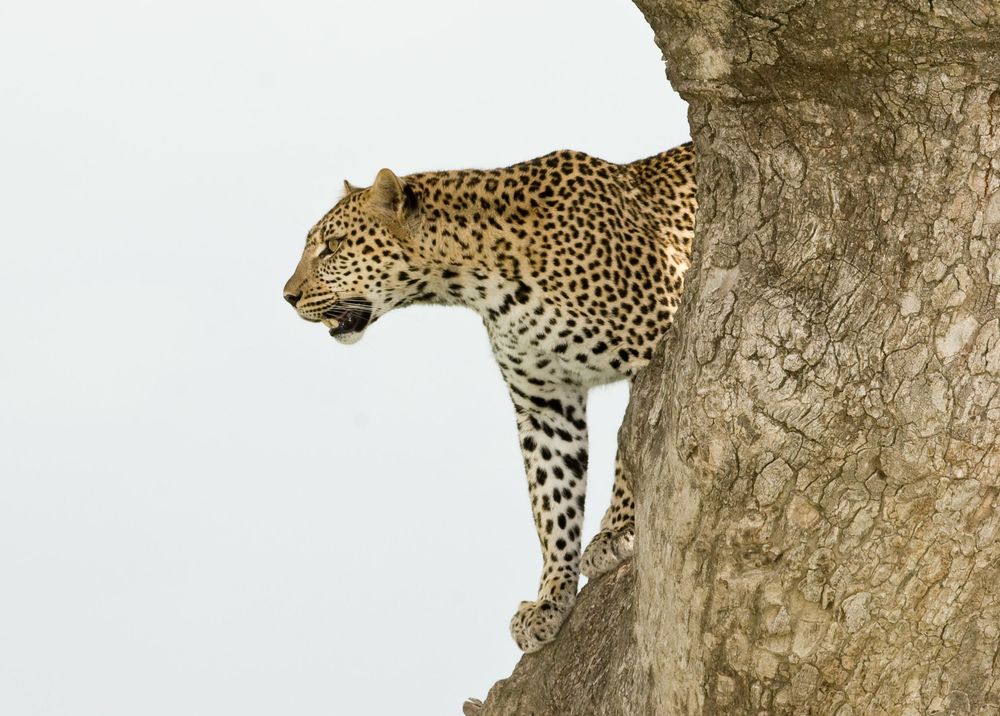
Leopards sometimes drag carcasses into trees to reduce the risk of losing a meal to scavengers such as hyenas. However, not every kill is carried into a tree, and the feasibility of lifting prey depends on the size of the carcass, the tree and the individual leopard.
Their climbing ability also provides safe resting places, elevated viewpoints and opportunities to avoid some ground-level threats.
Habitat and Distribution of the African Leopard
The African leopard has historically occupied a large part of the continent. It occurs in a wide range of habitats, although its distribution has become fragmented and many regional populations have declined.
Where do African leopards live?
African leopards may inhabit:
- Savannas and grasslands: Areas where scattered trees, shrubs and tall grasses provide cover for stalking prey.
- Woodlands: Landscapes with trees and dense vegetation that offer resting places and ambush opportunities.
- Riverine forests: Vegetation along rivers and drainage channels, where water, prey and tree cover may be concentrated.
- Tropical forests: Forest habitats that support suitable prey and sufficient cover.
- Rocky hills and mountains: Terrain with crevices, ledges and sheltered resting sites.
- Semi-arid landscapes: Drier regions where prey, water and suitable refuges remain available.
Leopards are adaptable, but adaptability does not make them immune to habitat destruction. Roads, settlements, agricultural expansion and other human activities can fragment populations and increase the risk of conflict.
Where are African leopards found?
Leopards remain present in parts of eastern, central, western and southern Africa. Their abundance and conservation outlook vary considerably across the continent.
Tanzania, Kenya, Zambia, Botswana, Namibia and South Africa are among the countries associated with well-known leopard-viewing destinations. Leopards also survive in many less frequently visited and more difficult-to-survey areas.
A landmark scientific study published in 2016 found that the leopard as a species occupied only about 25–37% of its estimated historical range worldwide. It estimated that African leopard range had contracted by approximately 48–67%, with West Africa experiencing particularly severe losses of around 86–95%.
These are historical range estimates from a published study, not a current census of leopard numbers. They also describe geographic range loss, which is not the same as a directly measured percentage decline in population size.
Leopards in the Serengeti: Why Seronera Valley Is Important
Serengeti National Park in northern Tanzania is one of Africa’s most celebrated wildlife destinations. Its ecosystems include open grasslands, woodlands, riverine forests, swamps and rocky outcrops, supporting a rich diversity of wildlife.
Among the park’s most sought-after predators is the African leopard.
Why is Seronera famous for leopard sightings?
Seronera Valley, in the central Serengeti, is widely regarded as one of the park’s better areas for looking for leopards.
Several ecological features make the area attractive to these cats:
- Riverine woodland: Trees and dense vegetation provide shade, concealment and elevated resting places.
- Prey availability: Suitable prey species support resident predators.
- Permanent water and drainage corridors: These features help sustain vegetation and wildlife through changing seasons.
- Suitable trees: Mature trees, including sausage trees and acacias in appropriate locations, provide branches where leopards may rest or cache prey.
A leopard can lie along a branch for hours, almost invisible against the bark and leaves. Experienced safari guides often scan the canopy as carefully as the ground, looking for a curved tail, a spotted limb or an unusual shape in the branches.
Seronera is a strong choice for travelers hoping to see a leopard, but no location guarantees a sighting. Leopards are naturally elusive, and visibility varies with season, weather, animal movements and the time spent searching.
Best time to look for leopards in the Serengeti
Leopards live in the Serengeti throughout the year, so a sighting does not depend exclusively on the Great Migration.
Early morning and late afternoon game drives can offer good opportunities to observe leopard activity. These periods coincide with cooler conditions and the low-light hours when leopards are often more active.
Midday sightings are also possible, especially when a leopard is resting in a tree or sheltered vegetation.
Visitors should follow park regulations, remain with their guide and avoid disturbing animals or approaching a leopard on foot.
African Leopard Behavior and Social Structure
Are African leopards solitary?
Yes. Adult leopards are primarily solitary animals. They generally hunt alone and maintain individual home ranges, although these ranges may overlap with those of other leopards.
The main exception is the relationship between a mother and her dependent cubs. Mating pairs may also spend time together, and neighboring animals can interact at territory boundaries or shared marking sites.
Solitary does not mean socially disconnected. Leopards communicate with one another and respond to the presence, scent and movements of other individuals.
How do leopards communicate?
Leopards use several forms of communication:
- Scent marking: Urine, feces and glandular secretions convey information about an animal’s presence and may help communicate reproductive or territorial status.
- Scratching: Trees and other surfaces may be scratched, leaving visible marks and potentially depositing scent.
- Vocalizations: Leopards produce a range of sounds, including a distinctive harsh, sawing call.
- Body language: Posture, facial expressions and other visual signals can communicate intentions during close encounters.
These behaviors help leopards reduce unnecessary confrontations, locate potential mates and navigate overlapping territories.
Do leopards have territories?
Leopards use home ranges whose sizes depend on prey availability, habitat quality, sex, population density and other ecological factors.
In prey-rich environments, a leopard may be able to meet its needs within a relatively small area. In less productive landscapes, it may need a much larger range.
Male home ranges often overlap with those of several females. Female ranges may also overlap, although the extent and pattern of overlap differ among populations.
It is therefore misleading to assign one universal territory size to every African leopard.
African Leopard Diet and Hunting Techniques
The African leopard is a carnivore and an opportunistic hunter. Its diet varies with habitat, prey availability, season and the size of the individual leopard.
What do African leopards eat?
Common prey categories include:
- Small and medium-sized antelopes, including impala and gazelles where available.
- Larger antelopes, such as kudu and nyala, depending on local conditions and prey size.
- Warthogs and other wild pigs.
- Monkeys and other small or medium-sized mammals.
- Rodents, hares and other small animals.
- Birds and, occasionally, reptiles or aquatic prey.
- Domestic animals in some landscapes where livestock is accessible.
Leopards do not depend on a single prey species. This dietary flexibility is one reason they can survive in different environments, although local prey depletion can still cause serious declines.
How do leopards hunt?
Leopards rely mainly on stealth, concealment and a short, powerful attack rather than prolonged pursuit.
A typical hunt may involve moving quietly through cover, approaching prey within striking distance and launching a sudden pounce. A successful capture can then be followed by a bite to the throat or neck, depending on the prey and circumstances.
Their spotted coat helps camouflage them in vegetation and broken light. Their powerful limbs and sharp claws support grappling, climbing and carrying prey.
Leopards may hunt during the day, at dusk or at night. They are often described as nocturnal and crepuscular, but their activity patterns are flexible and can change according to disturbance, prey behavior and local conditions.
Why do leopards carry prey into trees?
A leopard may drag a carcass into a tree to reduce the chance that competing carnivores will steal it. This behavior is particularly useful in areas where hyenas and lions compete for food.
Tree caching is not universal. Some prey is too heavy to lift, some habitats lack suitable trees, and some carcasses are consumed on the ground.
Leopards are also capable swimmers, and observations from some populations show that they may take aquatic prey such as fish or crabs when opportunities arise.
African Leopard Reproduction and Cubs
When do leopards breed?
Leopards can breed throughout the year, although breeding patterns may vary with location and environmental conditions.
Gestation generally lasts around 90–105 days. Females commonly give birth to two or three cubs, although litter sizes vary.
A female usually selects a sheltered den in dense vegetation, a rocky refuge or another concealed location where newborn cubs are less exposed to predators and disturbance.
How do leopard cubs survive?
Leopard cubs are born helpless and depend on their mother for food, warmth and protection.
During their early development, the mother leaves them hidden while she hunts. She may relocate them to new hiding places as they grow or when the original location becomes unsafe.
As the cubs mature, they begin following their mother, playing, stalking and practicing the movements they will eventually use to hunt. They learn to recognize prey, avoid danger and use their environment effectively.
Young leopards often remain dependent on their mother for approximately 18–24 months, although the timing varies. They eventually disperse and establish their own home ranges.
Why is cub mortality high?
Young leopards face risks from starvation, disease, predation and other environmental pressures. Competition with other predators can also affect their survival.
Infanticide has been documented in leopards. In some circumstances, an incoming male may kill dependent cubs that he did not sire, potentially allowing the female to return to reproductive condition sooner. However, this behavior is not inevitable, and its occurrence varies among individuals and circumstances.
The survival of leopard cubs is important for maintaining local populations, particularly in areas where adult mortality is high or populations have become isolated.
African Leopard Conservation Status and Threats
The leopard is classified as Vulnerable globally in the IUCN Red List assessment cited in the sources below. This assessment concerns Panthera pardus as a species. Regional populations can face more severe threats, and their status should be assessed using region-specific evidence.
The African leopard has suffered extensive historical range loss, and population trends are not uniform across the continent. Some protected landscapes continue to support leopards, while other areas have experienced severe declines or local disappearance.
1. Habitat loss and fragmentation
Agriculture, settlements, roads, mining and other developments can destroy or divide leopard habitat.
Fragmentation reduces access to prey and suitable refuges and may prevent leopards from moving between populations. Smaller, isolated populations can become more vulnerable to local extinction and loss of genetic diversity.
2. Declining prey populations
Leopards need sufficient wild prey to survive and reproduce. Unsustainable hunting, snaring and the commercial bushmeat trade can reduce the abundance of animals on which they depend.
A landmark study cited in the IUCN assessment found an average decline of approximately 59% in monitored large-herbivore populations across 78 protected areas in parts of Africa between 1970 and 2005. This statistic describes prey populations in the surveyed areas and period, not a measured 59% decline in leopard numbers.
3. Human–leopard conflict
Leopards may kill livestock or domestic animals where natural prey is scarce or livestock is poorly protected.
Retaliatory killing can follow livestock losses, particularly where communities bear the economic costs of living alongside wildlife. Preventing conflict requires practical measures that protect livestock while maintaining viable leopard populations.
Potential approaches include secure livestock enclosures, improved herding practices, community-led monitoring, rapid responses to livestock losses and fair, locally appropriate compensation or incentive schemes.
4. Illegal killing and wildlife trade
Leopards may be killed for their skins and other body parts, for cultural or commercial purposes, or through snares intended for other animals.
Illegal trade and poorly controlled hunting can place additional pressure on populations, particularly when combined with habitat loss and declining prey.
5. Road development and other human pressures
Roads can increase habitat fragmentation and make previously inaccessible areas easier to enter for hunting or other disruptive activities.
Traffic can also kill wildlife, while expanding human activity can reduce the availability of secure resting and breeding habitat.
How Can African Leopards Be Protected?
Effective leopard conservation requires more than protecting individual animals. It involves maintaining connected habitats, healthy prey populations and conditions that allow people and wildlife to coexist.
Important conservation measures include:
- Protecting and restoring natural habitat and wildlife corridors.
- Reducing unsustainable hunting of wild prey.
- Strengthening enforcement against illegal killing and wildlife trafficking.
- Supporting communities that experience the costs of living near large carnivores.
- Improving livestock protection and reducing opportunities for conflict.
- Monitoring leopard populations with camera traps, spoor surveys and other reliable methods.
- Promoting responsible wildlife tourism that respects animal welfare and park regulations.
Safari tourism can contribute to conservation when it supports habitat protection, local employment and responsible wildlife management. Tourism alone, however, cannot guarantee the survival of leopard populations.
Where to See African Leopards on Safari
Leopard sightings are never guaranteed, but several African destinations are known for offering opportunities to search for these elusive cats.
1. Serengeti National Park, Tanzania
The central Serengeti, especially the Seronera Valley and its riverine woodland, is a well-known leopard-viewing area. Mature trees and suitable prey make this region a useful starting point for visitors hoping to see a leopard.
Official park information describes the Serengeti as a diverse ecosystem containing grasslands, riverine forests, woodlands, swamps and rocky outcrops.
2. South Luangwa National Park, Zambia
South Luangwa is recognized for its leopard-viewing opportunities and varied riverine habitats. Leopards can be encountered during game drives, but sightings depend on conditions and animal movements.
Claims that this park has a specific density, such as one leopard per two square kilometres, should not be repeated without a clearly identified, credible survey and an explanation of the area and methodology involved.
3. Sabi Sand Game Reserve, South Africa
Sabi Sand, which borders Kruger National Park, is well known for leopard-focused wildlife viewing. Some leopards in established tourism areas are relatively accustomed to safari vehicles, allowing visitors to observe natural behavior under appropriate guiding and viewing rules.
4. Moremi Game Reserve, Botswana
Moremi, in the Okavango Delta region, contains a mosaic of floodplains, woodland and riverine habitats. These landscapes support prey and provide cover for leopards.
5. Maasai Mara, Kenya
The Maasai Mara ecosystem offers leopard-viewing opportunities in areas with suitable cover, including river corridors and woodland. Sightings vary with location, season and individual animal movements.
Tips for spotting a leopard in the wild
- Choose a reputable safari operator with knowledgeable local guides.
- Ask guides to scan trees, shaded branches, rocky outcrops and dense vegetation.
- Be patient: a leopard may remain concealed or rest for long periods.
- Carry binoculars to help distinguish an animal from branches and shadows.
- Take early-morning and late-afternoon drives when practical.
- Respect viewing distances, avoid crowding animals and follow all guide instructions.
Interesting Facts About African Leopards
- Every leopard has a distinctive coat pattern. Rosettes vary between individuals and can help researchers identify them in photographs.
- Leopards are excellent climbers. They regularly use trees for resting, observing their surroundings and sometimes storing prey.
- They are adaptable hunters. Their diet can include animals ranging from small mammals to medium-sized antelopes.
- They communicate through scent. Scent marking helps convey information about presence and reproductive status.
- They produce a distinctive sawing call. The harsh, rasping sound can carry through woodland and is very different from the lion’s roar.
- Black leopards are not a separate species. Their dark coloration is caused by melanism, a genetic condition that increases dark pigmentation. Their markings may still be visible in suitable light.
- They can swim. Leopards are capable swimmers, and some populations take aquatic prey opportunistically.
- They are members of the Big Five. The traditional African safari Big Five consists of the lion, leopard, elephant, African buffalo and rhinoceros.
- They are not immune to human pressure. Their adaptability allows them to occupy diverse habitats, but it does not prevent population decline when prey and habitat disappear.
- There is no reliable single global population count. Leopards are difficult to survey across their vast and fragmented range, so a precise worldwide total should not be presented as established fact.
Frequently Asked Questions About African Leopards
1. What is the scientific name of the African leopard?
The African leopard is commonly identified as Panthera pardus pardus, a subspecies of the leopard species Panthera pardus.
2. Are African leopards endangered?
The leopard is classified as Vulnerable globally in the IUCN assessment cited here. Some regional populations are more severely threatened. A global category should not be taken to mean that every leopard population faces the same level of risk.
3. How many African leopards are left in the wild?
There is no reliable, comprehensive count of all wild African leopards. Their secretive behavior, large home ranges and presence across difficult-to-survey landscapes make continent-wide estimates challenging. Population estimates should be tied to a specific region, survey method and date.
4. Where is the best place to see a leopard in Tanzania?
The Seronera Valley in the central Serengeti is one of Tanzania’s best-known areas for leopard sightings. Its riverine woodland, trees and prey provide suitable conditions, but no sighting is guaranteed.
5. What is the best time to see leopards in the Serengeti?
Early morning and late afternoon game drives are useful times to look for leopards. They may also be seen resting in trees during the day. Leopards are present year-round, so sightings are not dependent on the Great Migration alone.
6. What do African leopards eat?
They eat a wide variety of animals, including antelopes, warthogs, monkeys, rodents, birds and other available prey. Their diet varies with local prey abundance and habitat.
7. Why do leopards carry their prey into trees?
They may carry carcasses into trees to reduce the risk of losing food to competing carnivores, especially hyenas. Not all kills are cached in trees.
8. Are African leopards solitary animals?
Yes. Adults are primarily solitary, apart from mating interactions and the period when mothers raise their cubs. Individuals may nevertheless share parts of their home ranges and communicate through scent marking.
9. How many cubs does a leopard have?
A female commonly gives birth to two or three cubs after a gestation period of roughly three months. Litter size and reproductive timing vary.
10. How long do leopard cubs stay with their mother?
Cubs often remain dependent on their mother for approximately 18–24 months. During this period, they develop hunting skills and learn to navigate their environment.
11. What is the difference between a leopard and a cheetah?
Leopards have muscular bodies, rosette-shaped markings and strong climbing abilities. Cheetahs are more slender, have solid black spots and distinctive tear marks on their faces, and are specialized for high-speed pursuit in open terrain.
12. Are black panthers African leopards?
A black panther in Africa is typically a melanistic leopard. The term describes an animal with unusually dark pigmentation rather than a separate leopard species.
13. Do African leopards attack humans?
Leopards generally avoid people, but attacks can occur. Risk may increase if an animal is cornered, injured, surprised at close range or habituated to people. Visitors should never approach or attempt to feed a wild leopard.
14. Can leopards live outside protected areas?
Yes. Leopards can survive in some human-modified landscapes, including areas near farms or settlements, when sufficient prey, cover and space remain. However, these environments can increase the risk of conflict, illegal killing and road mortality.
15. Why are African leopards important to the ecosystem?
As predators, leopards contribute to food-web relationships and help regulate populations of their prey. Their presence is also important to the biodiversity and ecological value of many African landscapes.
16. What are the biggest threats to African leopards?
The principal threats include habitat loss and fragmentation, declining prey populations, illegal killing, wildlife trafficking and retaliatory killing following livestock losses.
17. How can tourists help conserve leopards?
Visitors can choose responsible safari operators, follow park regulations, avoid disturbing animals, support conservation initiatives and respect local communities. Tourism is most beneficial when it contributes to long-term habitat protection and community well-being.
Conclusion: Protecting Africa’s Elusive Big Cat
The African leopard is a remarkable predator whose strength, camouflage, climbing ability and flexible diet allow it to survive in a wide variety of environments. From the riverine woodlands of Tanzania’s Serengeti to the forests and savannas of other African countries, it remains one of the continent’s most fascinating wild cats.
Yet adaptability should not be mistaken for security. Historical range loss, habitat fragmentation, declining prey populations and conflict with people threaten leopards across many parts of Africa. Protecting them requires connected habitats, sustainable wildlife management, effective action against illegal killing and practical support for communities sharing their landscapes.
For safari travelers, the Seronera Valley offers an excellent opportunity to search for African leopards in their natural environment. For conservationists and local communities, the larger goal is to ensure that these elusive cats continue to thrive beyond the boundaries of famous parks.
The future of the African leopard depends on preserving not only the animal itself, but also the habitats, prey and coexistence that make its survival possible.
Scientific References and Further Reading
Use these sources to support the article’s biological and conservation claims. Review the latest versions before republishing numerical conservation statistics.
- International Union for Conservation of Nature (IUCN). Panthera pardus — The IUCN Red List of Threatened Species. The assessment provides information on conservation status, range, threats and population trends.
https://www.iucnredlist.org/
- Jacobson, A. P., et al. (2016). Leopard (Panthera pardus) status, distribution, and the research efforts across its range. PeerJ, 4, e1974.
https://doi.org/10.7717/peerj.1974
- San Diego Zoo Wildlife Alliance. Leopard facts and information, including physical characteristics, reproduction and behavior.
https://animals.sandiegozoo.org/animals/leopard
- National Geographic. Leopard facts, hunting behavior, camouflage, tree caching and reproduction.
https://www.nationalgeographic.com/animals/mammals/facts/leopard
- Tanzania National Parks (TANAPA). Official information about Serengeti National Park, its habitats, wildlife and visitor guidance.
https://www.tanzaniaparks.go.tz/serengeti
Editorial note: Conservation classifications, geographic distributions and population estimates can change as new assessments become available. Distinguish historical range estimates from current population counts, and avoid publishing exact density or population figures without a traceable, relevant source.
Environment
Habitat
The African leopard (Panthera pardus pardus) inhabits a wide range of environments across sub-Saharan Africa, including savannas, grasslands, open woodlands, tropical forests, riverine vegetation, rocky hills and mountainous regions. It is highly adaptable and can survive in semi-arid landscapes where sufficient prey, water and shelter are available. In Tanzania, the Serengeti National Park, particularly the Seronera Valley, is a well-known area for leopard sightings because its riverine woodlands provide excellent cover and suitable trees for resting and storing prey.
Survival
Diet
The African leopard is a carnivore and an opportunistic hunter. Its diet includes antelopes such as impala, gazelles and kudu, as well as warthogs, monkeys, rodents, hares, birds and other small or medium-sized animals. It may occasionally prey on livestock where wild prey is scarce. Leopards rely on stealth, camouflage and short bursts of speed to ambush their prey. They sometimes drag their kills into trees to protect them from scavengers such as hyenas and competing predators such as lions.
Natural History
Behaviour
African leopards are primarily solitary and territorial, usually hunting and resting alone except during mating or when females raise their cubs. They communicate through scent marking, scratching trees, vocalizations and body language. Often active at night, dawn and dusk, they can also be seen during the day. Their spotted coats provide excellent camouflage, while their muscular bodies, powerful limbs and sharp claws make them exceptional climbers. Leopards are capable swimmers and highly adaptable hunters. Females typically give birth to two or three cubs and care for them for approximately 18–24 months. Although elusive and generally avoidant of humans, leopards face growing threats from habitat loss, declining prey populations, illegal killing and human–wildlife conflict.