Swahili Culture: History, Traditions, Food and Life on the East African Coast
Along the shores of the Indian Ocean, from southern Somalia through Kenya and Tanzania to northern Mozambique, a distinctive culture grew around the sea.
Its cities were connected by dhows and maritime trade. Its streets were lined with coral-stone houses and carved wooden doors. Its markets brought together goods, languages and ideas from across the Indian Ocean.
This is the world of Swahili culture.
Swahili culture is not a single tradition frozen in the past. It is a living culture shaped by African roots, coastal communities, Islam, trade, migration, language, food, architecture and generations of interaction across the Indian Ocean.
Today, its influence can still be seen in places such as Zanzibar, Lamu, Mombasa and Kilwa, as well as in the Kiswahili language spoken by millions of people across Africa.
What Is Swahili Culture?
Swahili culture developed among communities along the East African coast and nearby islands.
The word Swahili comes from the Arabic sawāḥil, meaning “coasts,” but the history of the Swahili people and culture is fundamentally rooted in East Africa.
For centuries, coastal communities developed towns, trading networks, agricultural systems, religious institutions, artistic traditions and a distinctive maritime way of life.
The result was a culture that was African in its foundations while participating in an enormous Indian Ocean world.
UNESCO's heritage research emphasizes that the historical development of the Swahili people and language should be understood through their African and Bantu roots, alongside centuries of interaction with communities from across the Indian Ocean.
Where Is the Swahili Coast?
The Swahili Coast stretches along the western Indian Ocean.
Its historical communities extended from the southern coast of Somalia through Kenya and Tanzania and toward northern Mozambique, with important islands including Zanzibar, Pemba and the Lamu Archipelago.
Some of the best-known historic Swahili centres include:
- Lamu
- Mombasa
- Malindi
- Kilwa Kisiwani
- Zanzibar
- Pemba
- Bagamoyo
- Pate
- Gede
These places were not isolated settlements.
They were part of maritime networks connecting the East African coast with Arabia, Persia, India and other parts of the Indian Ocean world.
The History of Swahili Civilization
The history of Swahili culture reaches back more than a thousand years.
Coastal settlements grew as communities participated in regional and long-distance trade. By the medieval period, Swahili towns had become important centres of commerce and urban life.
Kilwa Kisiwani, off the southern coast of present-day Tanzania, became one of the most important of these centres.
UNESCO describes Kilwa Kisiwani and nearby Songo Mnara as exceptional evidence of the growth of Swahili culture and commerce between the 9th and 19th centuries. Their remains include mosques, palaces and domestic buildings constructed from coral stone.
Further north, Gede in present-day Kenya developed into a substantial Swahili urban settlement between roughly the 10th and 17th centuries.
Its ruins reveal sophisticated town planning, architecture, water systems and religious buildings. UNESCO describes Gede as evidence of the maritime trade networks that connected East Africa with the Arabian Sea and South Asia.
Islam and Swahili Life
Islam became an important part of Swahili culture over many centuries.
Mosques became central features of coastal towns, while Islamic scholarship, education and religious festivals became part of community life.
But Swahili culture should not be reduced to religion alone.
African customs, family structures, food traditions, language and local social practices continued to shape coastal life.
The result was a distinctive cultural tradition in which Islam became deeply embedded within an African coastal society.
Lamu is one of the clearest surviving examples.
The town has remained continuously inhabited for more than 700 years and continues to function as a centre of Swahili and Islamic culture. Its annual religious and cultural festivals are part of its living heritage.
Kiswahili: The Language of the Coast
Perhaps the most powerful legacy of Swahili culture is its language.
Kiswahili began along the East African coast but expanded far beyond the coastal communities where it developed.
Today, it is one of Africa's most important languages and a major language of communication across East and Central Africa.
UNESCO notes that Kiswahili is spoken by hundreds of millions of people across Africa and beyond and has become an important instrument of regional cultural and economic integration. UNESCO also established July 7 as World Kiswahili Language Day.
The language itself reflects the history of the coast.
Its grammatical foundation is Bantu, while its vocabulary contains words acquired through centuries of contact with other languages and cultures.
But Kiswahili is more than a record of historical exchange.
It is a living African language used in homes, schools, markets, media, music, literature and everyday conversation.
Swahili Architecture
Walk through an old Swahili town and the architecture immediately tells a story.
Coral stone walls.
Narrow streets.
Inner courtyards.
Carved wooden doors.
Shaded verandas.
Mosques.
Markets.
Houses designed around the realities of a hot and humid coastal environment.
Lamu Old Town is one of the finest surviving examples.
UNESCO describes it as the oldest and best-preserved Swahili settlement in East Africa, with architecture incorporating coral stone, mangrove timber, courtyards, verandas and elaborately carved doors.
Stone Town in Zanzibar offers another extraordinary example.
Its buildings reflect more than a millennium of cultural interaction while retaining distinctive Swahili elements. African, Arab, Indian and European influences can all be seen in its architecture and urban form.
The architecture is therefore not simply decorative.
It is a record of how people lived.
Swahili Food
Food is another way to understand the history of the coast.
Swahili cuisine reflects the geography of East Africa as well as centuries of movement across the Indian Ocean.
Rice, coconut, seafood, spices, grains, vegetables and meat all play important roles in different coastal food traditions.
Popular dishes and foods associated with the Swahili coast include:
- Pilau
- Biryani
- Chapati
- Samaki wa kupaka
- Coconut-based curries
- Mishkaki
- Viazi vya karai
- Mandazi
- Fresh tropical fruit and coconut dishes
Spices are particularly associated with Zanzibar and the wider coastal region.
But Swahili food is not simply “Indian food in Africa” or “Arab food in Africa.”
Its foundations developed from East African ingredients, agricultural traditions and coastal environments, while Indian Ocean exchange introduced new ingredients, techniques and combinations.
Research on Tanzanian Swahili food culture shows how coastal cuisine developed through interactions between inland East African communities, coastal environments, Islamic traditions and Indian Ocean trade.
The Dhow and the Indian Ocean
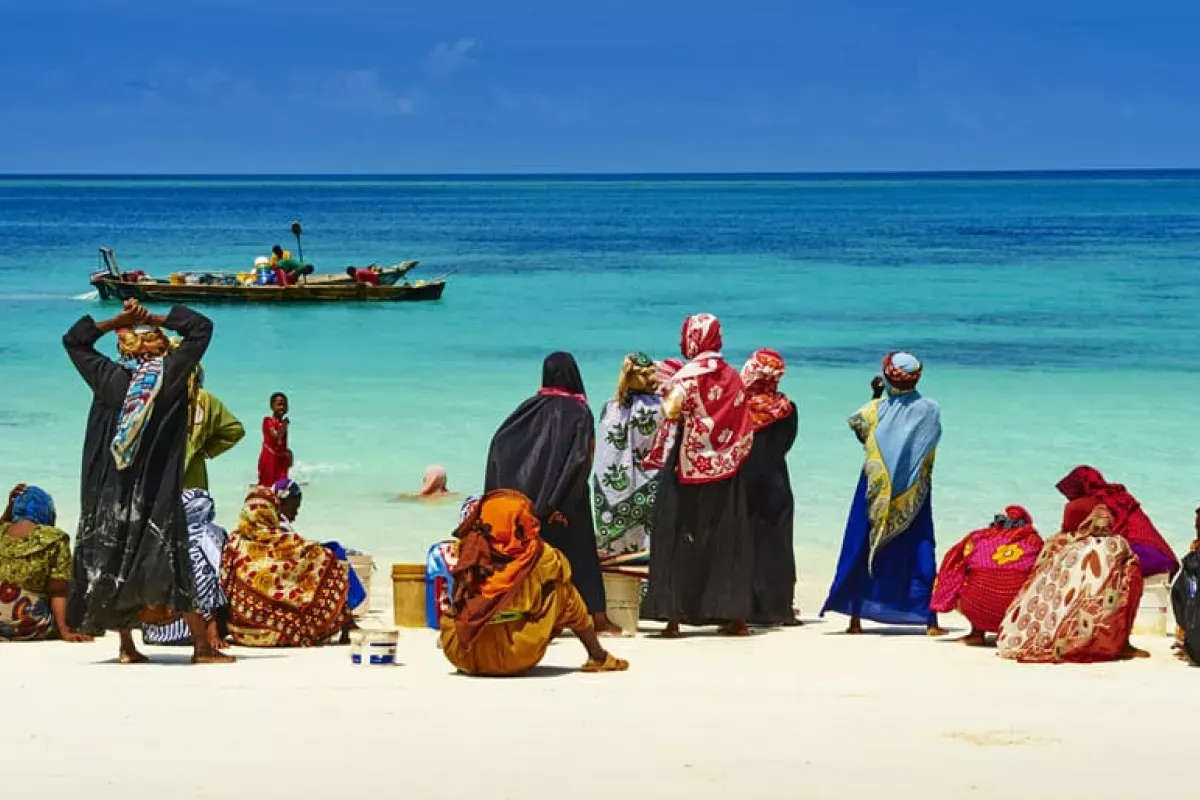
The sea is central to Swahili identity.
For centuries, dhows carried people and goods along the East African coast and across the Indian Ocean.
Sailors, merchants and fishing communities developed an intimate knowledge of winds, tides and seasonal movement.
The monsoon winds helped connect East Africa with Arabia and South Asia, allowing maritime networks to flourish.
This oceanic world shaped much more than commerce.
It influenced language, food, religion, architecture, clothing and the growth of coastal towns.
The Indian Ocean was not a barrier separating East Africa from the rest of the world.
For the Swahili coast, it was a highway.
Zanzibar and Swahili Culture
Zanzibar is perhaps the place most strongly associated with Swahili culture in the global imagination.
Its historic Stone Town preserves an extraordinary urban landscape of narrow streets, coral-rag buildings, carved doors and former merchant houses.
UNESCO describes Stone Town as an outstanding example of a Swahili trading town whose built environment reflects African, Arab, Indian and European influences accumulated over more than a millennium.
But Swahili culture is much larger than Zanzibar.
It belongs to a broad coastal world extending through Kenya, Tanzania and Mozambique, with connections farther north and across the Indian Ocean.
Zanzibar is one chapter in that much larger story.
Swahili Culture Today
Swahili culture is not simply something found in museums or archaeological sites.
It is still lived.
Kiswahili is spoken every day.
Swahili food is prepared in homes and restaurants.
Mosques remain important community spaces.
Traditional architecture continues to shape coastal towns.
Festivals bring communities together.
Music, poetry and storytelling continue to evolve.
And young people are finding new ways to express coastal identity through fashion, photography, film, music and digital culture.
This is what makes Swahili culture especially important to understand.
It is not an ancient civilization that disappeared.
It is a living African culture with deep historical roots and a contemporary future.
A Culture Shaped by Movement
The history of the Swahili coast reminds us that cultures are rarely created in isolation.
People moved.
Ideas moved.
Languages changed.
Foods travelled.
Religions spread.
Technologies were exchanged.
Families and communities built connections across the sea.
Yet the Swahili story should not be reduced to outside influences arriving on an African coast.
The coastal communities themselves shaped what emerged.
They created towns, languages, architecture, food traditions and social institutions that became distinctly Swahili.
That is the deeper story of Swahili culture.
It is a story of African roots and oceanic connections.
Why Swahili Culture Matters
From the ruins of Kilwa to the streets of Lamu and Stone Town, Swahili heritage tells a larger story about Africa's place in the Indian Ocean world.
It challenges the idea that Africa's history happened separately from the rest of the world.
For centuries, East African coastal societies participated in international trade, built sophisticated cities and developed cultural traditions that continue to influence millions of people.
And perhaps most importantly, Swahili culture remains alive.
Its language is spoken.
Its food is eaten.
Its architecture is inhabited.
Its festivals continue.
Its stories are still being told.
The Swahili Coast is not simply a place where history happened.
It is a place where history is still living.